
Human-Centred Collaborative Robotics: Exoskeletons as a Collaborative Technology for Industry and Logistics
The operational reality of many industrial and logistics companies continues to rely on physically demanding tasks: repetitive movements, manual lifting and handling of loads, work performed in awkward postures, or the execution of tasks requiring continuous effort throughout the shift. In the long term, these conditions lead to fatigue, reduced performance, and an increased risk of musculoskeletal injuries, particularly affecting the lower back and upper limbs.
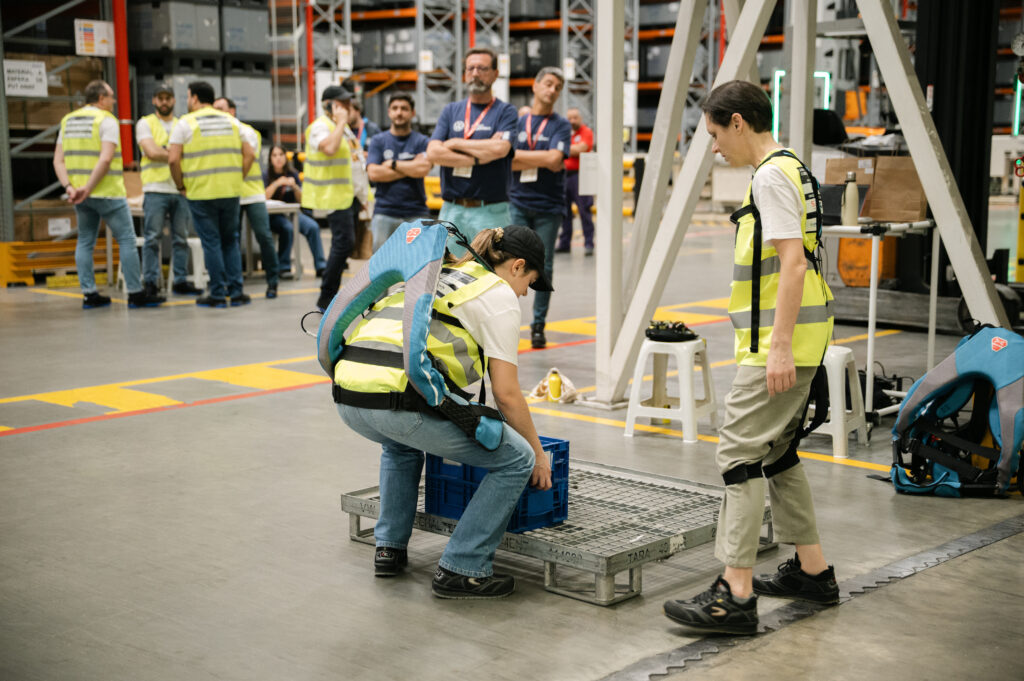
Beyond the human impact, this reality has direct consequences for operations. In Portugal, sick leave associated with lower back pain can last between 15 and 41 days. Even under the most optimistic scenario (15 days), the impact on a company goes far beyond salary costs, representing at a minimum a loss of productivity. It is estimated that this type of absence can cost around €1,771 per worker, including indirect costs such as team reorganization, increased workload for colleagues, and difficulties in finding qualified replacements. In a context where labour shortages and employee retention challenges are already structural issues, each absence becomes critical to maintaining operational continuity.
It is within this context that collaborative robotics is beginning to evolve towards new paradigms. Traditionally associated with cobots—robots designed to work side by side with humans within the same workspace—human–machine collaboration is now taking a further step forward.
Exoskeletons represent an evolution of collaborative robotics, where human–machine collaboration is no longer solely external—as with cobots—but becomes directly integrated into the operator’s body.
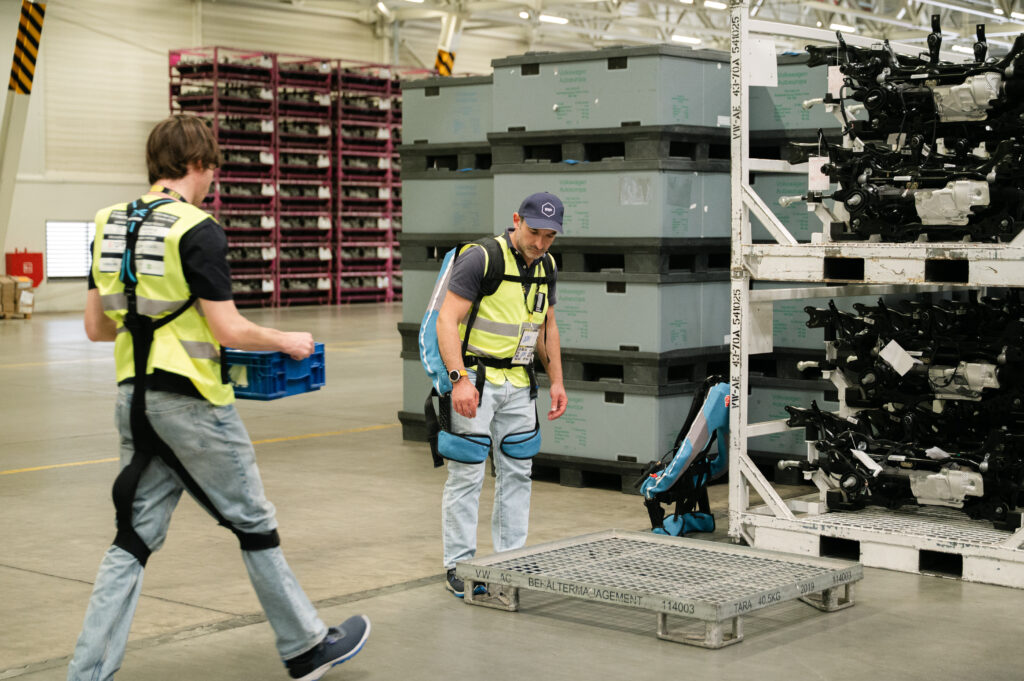
As a wearable or assistive robotics technology, exoskeletons are devices designed to support human movement, reduce physical strain, and improve workplace ergonomics. Unlike traditional automation solutions, they do not replace the operator or fundamentally alter the production process; instead, they enhance workers’ capabilities, enabling them to perform the same tasks with less fatigue and greater safety. As such, they represent an approach focused on prevention and the long-term sustainability of the workforce.
The choice of the most appropriate solution always depends on the operational context. There is no single type of exoskeleton suitable for every application. Factors such as the nature of the task, the weights involved, the frequency of movements, mobility requirements, and even the operator’s physical characteristics are all key considerations. For example, two operators performing the same job may benefit from different solutions due to differences in height, body mechanics, or individual ergonomics. This ability to adapt the technology to the user is one of the critical factors in ensuring both effectiveness and acceptance in real-world working environments.
The implementation of these technologies typically follows a progressive approach. In the initial phase, a pilot project is often conducted in a real working environment, enabling companies to assess the operational impact and gather feedback from users. The introduction of the equipment is supported by specific training, ensuring that teams understand both its proper use and the associated benefits. Adaptation is gradual: during the early stages, usage may be limited to a few hours per day, increasing progressively as users become more familiar with the equipment. In many cases, after around one month, integration becomes seamless, and the exoskeleton is naturally adopted as part of the worker’s daily equipment.
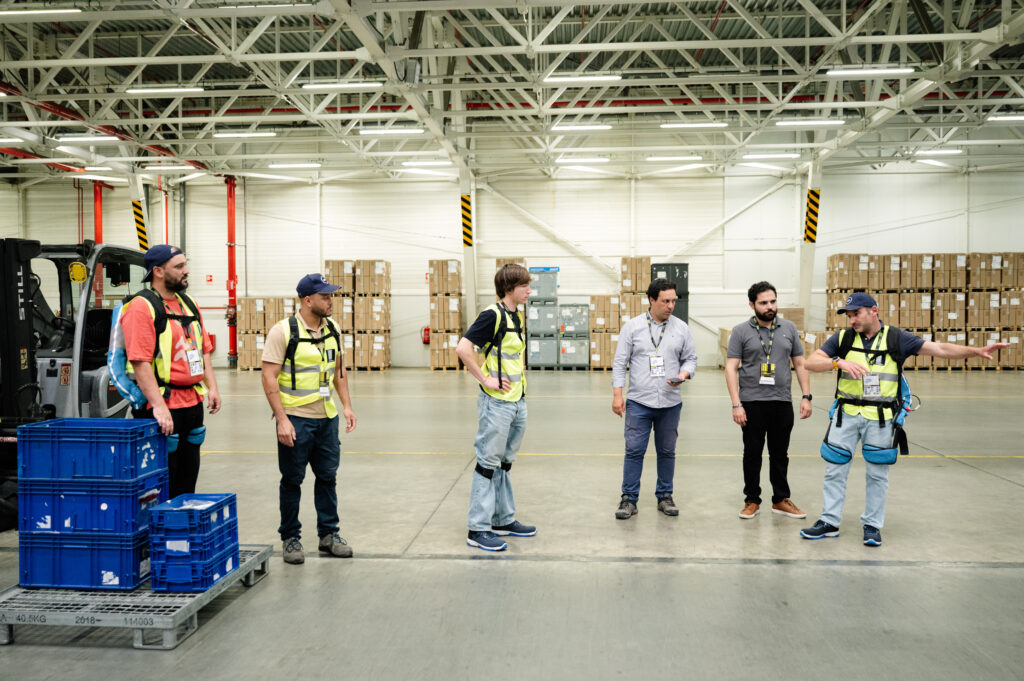
Applications are diverse and span a wide range of operational environments. In the logistics sector, exoskeletons are commonly used for picking, replenishment, loading and unloading, and manual handling tasks. In industrial settings, they are also applied in assembly, maintenance, and equipment operation support, such as for forklift and logistics train operators, where improved posture and reduced physical strain are particularly valuable—especially in operations that combine driving with the loading and unloading of materials. Across all these scenarios, the objective remains the same: to reduce the physical workload placed on workers without compromising operational efficiency.
More than a standalone technological solution, exoskeletons are part of a broader trend in industrial evolution. The transition towards Industry 4.0 and, more recently, Industry 5.0 places people at the centre of digital and technological transformation. Within this context, collaborative robotics is no longer viewed solely as a means of automation; it is increasingly recognised as a tool for enhancing and empowering human capital.
The integration of technologies that promote safety, ergonomics, and workplace sustainability will increasingly become a key differentiator for companies. Reducing the impact of injuries, improving talent retention, and ensuring better working conditions are not merely social concerns—they are also strategic decisions with a direct impact on productivity and competitiveness. As organisations face growing challenges related to workforce availability, employee well-being, and operational efficiency, investments in human-centred technologies are becoming essential. In this context, exoskeletons exemplify how innovation can simultaneously support business performance and workforce sustainability, contributing to safer, healthier, and more resilient workplaces.
In this context, collaboration between people and technology takes on a new meaning. It is no longer just about automating processes, but about creating the conditions for people to work better, for longer, and with less risk. It is precisely at this intersection of operational efficiency and workforce empowerment that collaborative robotics, in its most advanced form, reveals its true potential.
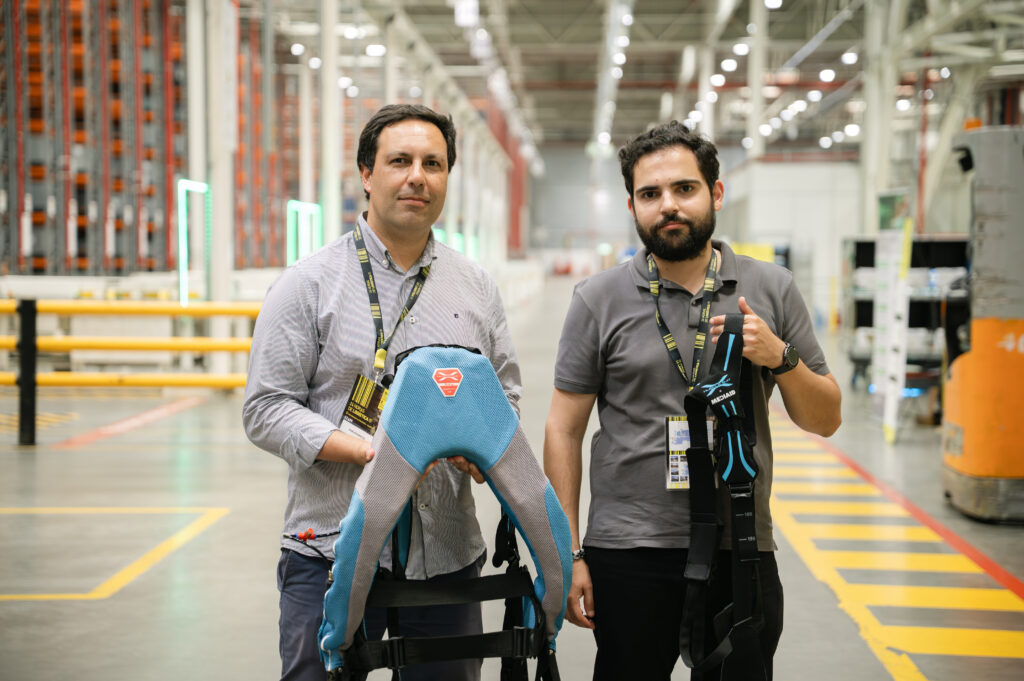
Highlights from iDR's participation in the 24 Horas Logística event at Autoeuropa 2026
Let's turn your ideas into reality?
Fill out the form and take the first step into the future with iDR®!