
Cobots in 2025: Myths, Facts, and What Companies Need to Know Before Investing
A automação colaborativa — através dos chamados cobots Collaborative automation — through so-called cobots (collaborative robots) — is no longer just a technological promise. By 2026, companies of all sizes and across multiple industrial sectors are integrating cobots into their daily operations to increase productivity, flexibility, and operational resilience. However, despite being widely discussed, many misconceptions still exist about what cobots actually do and where they truly add value.
In this article, we explore the most common myths and facts about cobots, based on credible industry studies, to help decision-makers assess more confidently whether investing in a cobot makes sense for their business.
Why Cobots Matter Today?
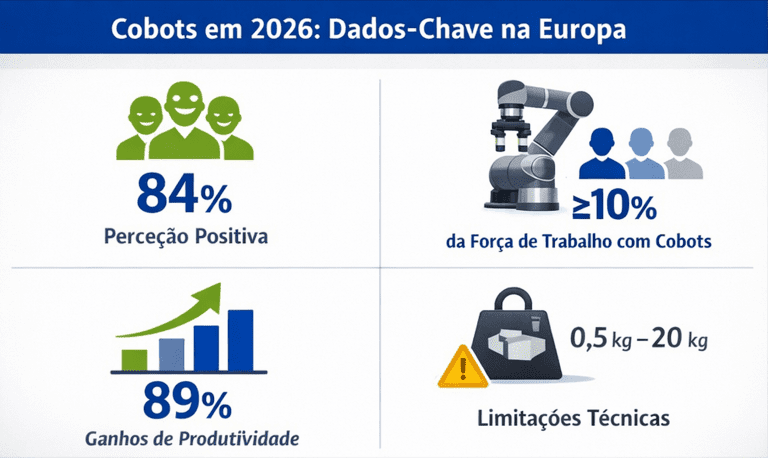
A recent report on the state of industrial automation in Europe shows that 84% of industrial professionals view the introduction of robots (including cobots) positively among employees,with only 3% reporting significant resistance. The study surveyed 2,174 business leaders across eight European countries, highlighting a clear cultural shift in how automation is perceived on the factory floor.
Additionally, among companies that have already adopted cobots:
- 93% expect at least 10% of their workforce to collaborate with cobots within the next decade;
- 47% believe that up to 25% of their workforce could work alongside cobots.
These figures demonstrate that, for many organizations, cobots are no longer “future technology” but a practical reality, already reshaping how work is organized.

Myth 1 – “Cobots Will Replace Human Workers”
Reality:
Cobots are designed to complement human work, not replace it. They are particularly effective in repetitive, physically demanding, or potentially hazardous tasks, allowing employees to focus on roles that require reasoning, adaptability, and decision-making.
In fact, the same European study found that most respondents believe robots will create more jobs than they eliminate by 2030. Moreover, cobots are expected to reduce talent shortages by at least 10%,with 44% of respondents predicting a reduction of 25% or more.
Conclusion: Cobots may change the nature of certain roles, but there is no evidence that they are a direct cause of mass unemployment in industry.
Myth 2 – “Cobots Are Suitable for Any Type of Production”
Reality:
Although cobots are highly versatile, they are not a universal solution for all production environments.
Technical limitations such as:
- Payload capacity — most cobots handle loads between approximately 0.5 kg and 20 kg, depending on the model and application;
- Safety and regulatory compliance requirements;
- Integration with existing systems;
all influence whether a cobot is suitable for a specific task.
In high-volume production or heavy-load applications,traditional industrial robots may still be more efficient than lightweight collaborative robots.
Conclusion: Before investing, companies should assess the technical suitability of cobotsbased on payload, speed, repeatability, and integration requirements.
Myth 3 – “Implementing a Cobot Is Complex and Disruptive”
Reality:
While automation is often associated with high investment and major operational disruption, cobots are specifically designed to be more “plug & play” than traditional industrial robots.
Market studies show that many cobots offer:
- Significantly lower installation costs;;
- Intuitive programming,, muitas vezes possível com interfaces gráficas ou ensino por demonstração;
- High redeployment flexibility,allowing the same unit to be reassigned to different tasks over time.
These factors lower the entry barrier for SMEs that previously avoided automation due to cost or complexity concerns. However, ROI still depends on the application and quality of integration.
Conclusion: Implementation is generally more accessible, but it still requires proper planning and technical support.
What Companies Should Evaluate Before Investing in a Cobot?
Before launching a collaborative automation project, consider the following:
- Task suitability
Identify whether the task is repetitive, physically demanding, or precision-based — areas where cobots typically deliver the greatest value.
- Safety and compliance
Assess applicable safety standards, certifications, and risk assessments.
- Integration with existing systems
Evaluate the time and resources required to integrate cobots with machinery, control systems, and existing software.
- Profitability and ROI
Calculate a realistic return on investment, including training, maintenance, and the potential for future redeployment to new tasks.

Conclusion
Cobots are not a magic solution that instantly solves all production challenges — but they are proven, high-value tools when applied in the right context.
Data shows that perceptions of automation are becoming increasingly positive;
Cobot adoption is growing across Europe and globally;
Companies are achieving tangible gains in productivity and flexibility;
However, success depends on technical analysis, planning, and alignment with business goals.
When adopted with clear criteria and a well-defined strategy, cobots can transform processes, improve performance, and strengthen competitiveness — especially for SMEs and industrial companies operating in increasingly demanding markets.
To learn more about collaborative robots, click here. To schedule a meeting and discuss cobot solutions for your business, please complete this form.
Sources:
Relatório State of Industrial Automation Report 2025,Universal Robots
“2025 Key Trends in Collaborative Robots”, Qviro
Image Credits: AI-generated
Let's turn your ideas into reality?
Fill out the form and take the first step into the future with iDR®!